
Maui housing stock is not Mainland housing stock. The plantation-era cottages along the Wailuku side of Iao Valley sit on raised pier-and-post foundations that flex when a piano dolly crosses them. Upcountry estates above Pukalani and Makawao are spread across two and three acres with detached ohana cottages, equipment barns and garden sheds that all factor into the inventory. The newer Kihei single-stories sit on shoulder-high lava-rock walls that mean a thirty-foot carry from the curb. Wailea oceanfront properties on the Mokapu and Wailea Beach side have private gate codes, salt-air-corroded outdoor hardware and HOA boards that want a COI on file before the gate opens. Kai Akamai walks every whole-property estimate himself and writes the figure off what he actually sees, not off a phone description.
The Iao-side plantation cottage to the Wailea oceanfront estate
Whole-property flats start at $1,890 for a tight two-bedroom Wailuku plantation cottage and run into the high teens for the multi-structure Upcountry compounds. There is no hourly meter on a whole-house book; the figure is signed at the in-home walk-through and the only thing that moves it is a written change-order you initial. Pono leads the on-island whole-house crews, Marcus runs the loads that are going into a container for off-island or mainland transit, and Tyler Aiona writes the binding number off a one-hour walk in the home or a slow video tour for off-island clients who are buying into Maui sight-unseen.
Salt-air discipline on every wood surface that leaves the truck
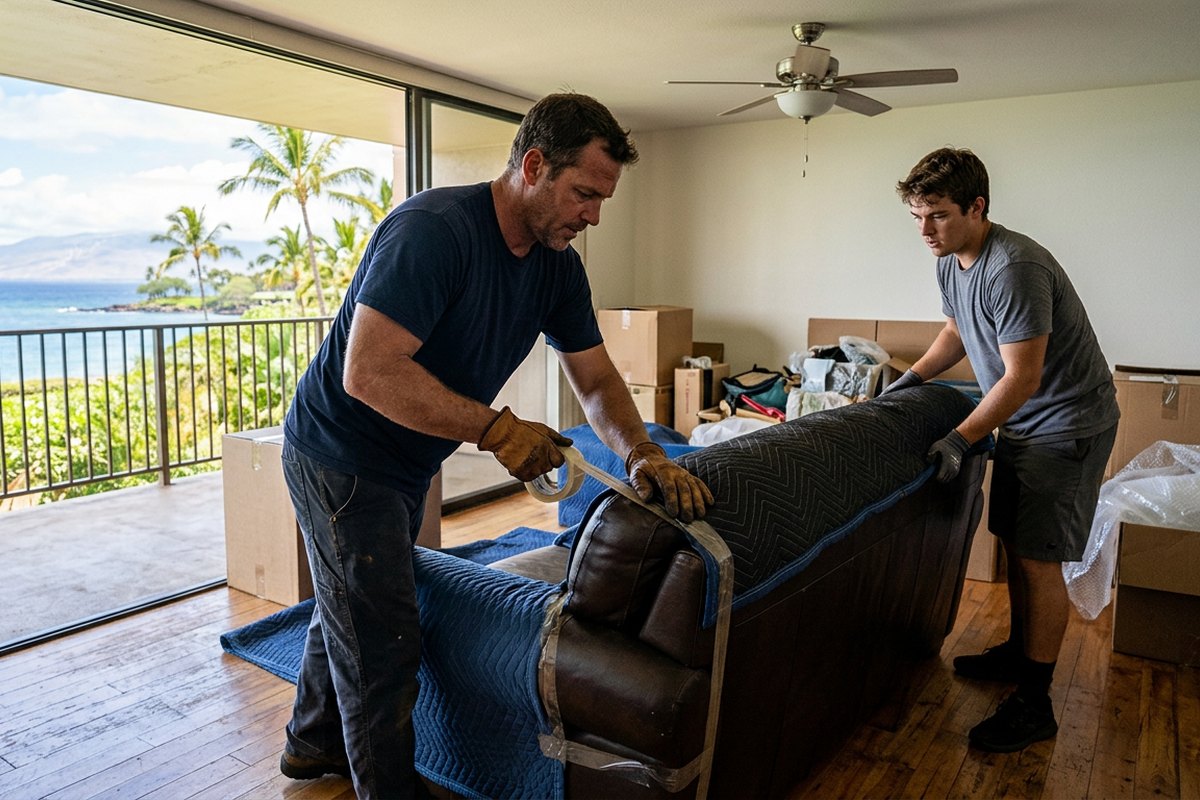
The single biggest difference between a Maui whole-house move and a mainland whole-house move is the wrap. Koa hutches and milo dining tables and that mango-wood platform bed in the master need a doubled moisture barrier because Maui’s trade-wind humidity stays at 75 percent year-round and salt-air corrosion starts in the first ninety minutes of exposure. Pono’s crew wraps in the bedroom, not at the truck, and the wrap stays on until the piece is in its new room on the destination side. Leather sofas get a separate silica-pad layer between the cushion and the wrap because leather and humidity-trap plastic do not coexist for more than a day without sweating.
What's Covered
- Kai or Tyler walks every whole-property job in person before writing the binding flat, including the detached ohana cottages and barn structures on Upcountry compounds
- Doubled trade-wind moisture wrap on every koa, milo, mango-wood and solid-wood piece, applied in the source room and not removed until the piece is in its destination room
- Pier-and-post plantation-foundation walk plates pre-staged before any piano, hutch or upright safe crosses the floor in Wailuku Iao-side and Paia plantation homes
- Wailea Beach Villas, Kapalua Bay, Honua Kai, Maui Meadows HOA COI request packet pulled by Nalani seventy-two hours ahead with the property manager confirmed by text
- Dual-truck staging on five-bedroom Upcountry and Wailea oceanfront estates so a 12,000-pound household clears origin in a single dispatch day
- End-of-day condition walk-through with the homeowner room by room, signed off by Pono before the crew releases
What's the Cost?
Two uniformed Akamai-crew W-2 movers plus the 26-ft straight truck post out of the Wakea Avenue gate at $195 an hour; for a studio, junior one-bedroom or a tight in-building lanai-to-lanai swap that slots cleanly into a half-day, Tyler will lock it as a flat figure instead, opening at $595 all-in.
Everything the day calls for is folded into that hourly figure: the two W-2 movers themselves, the 26-ft We Move People truck, quilted blankets, masonite floor runners, two-wheel and four-wheel dollies, ratchet straps, walk-boards, and the trade-wind humidity mats we put down off the porch in any month with salt on the sidewalk. Fuel adders, third-floor stair charges, long-carry charges from the alley to the door — none of those line items show up on a We Move People invoice, period.
Get My Quote